
Colorized Coins
Steve: World mints and coin manufacturers are being increasingly innovative in trying to make exciting and “new” coins for buyers. One avenue pursued in the sake of novelty are “colorized” coins, where vivid colors are introduced on the surface of the coin during the production process. This is distinguished from a coin like a beautiful rainbow toned 1881-S Morgan dollar that acquires natural colors over time due to the oxidization of the planchet’s metal.
When going through some older auction catalogs, I came across an early example of a “colorized” numismatic piece: a Holy Roman Empire silver thaler-sized piece of Maximilian I with Maria von Burgund as Duke and Duchess of Burgundy celebrating their marriage. It is dated 1479 though was struck after 1511 and features gilding in the hair. The resulting two-toned coloration makes it stand out visually, with the resulting bright hair contrasting against the steel-grey surfaces.
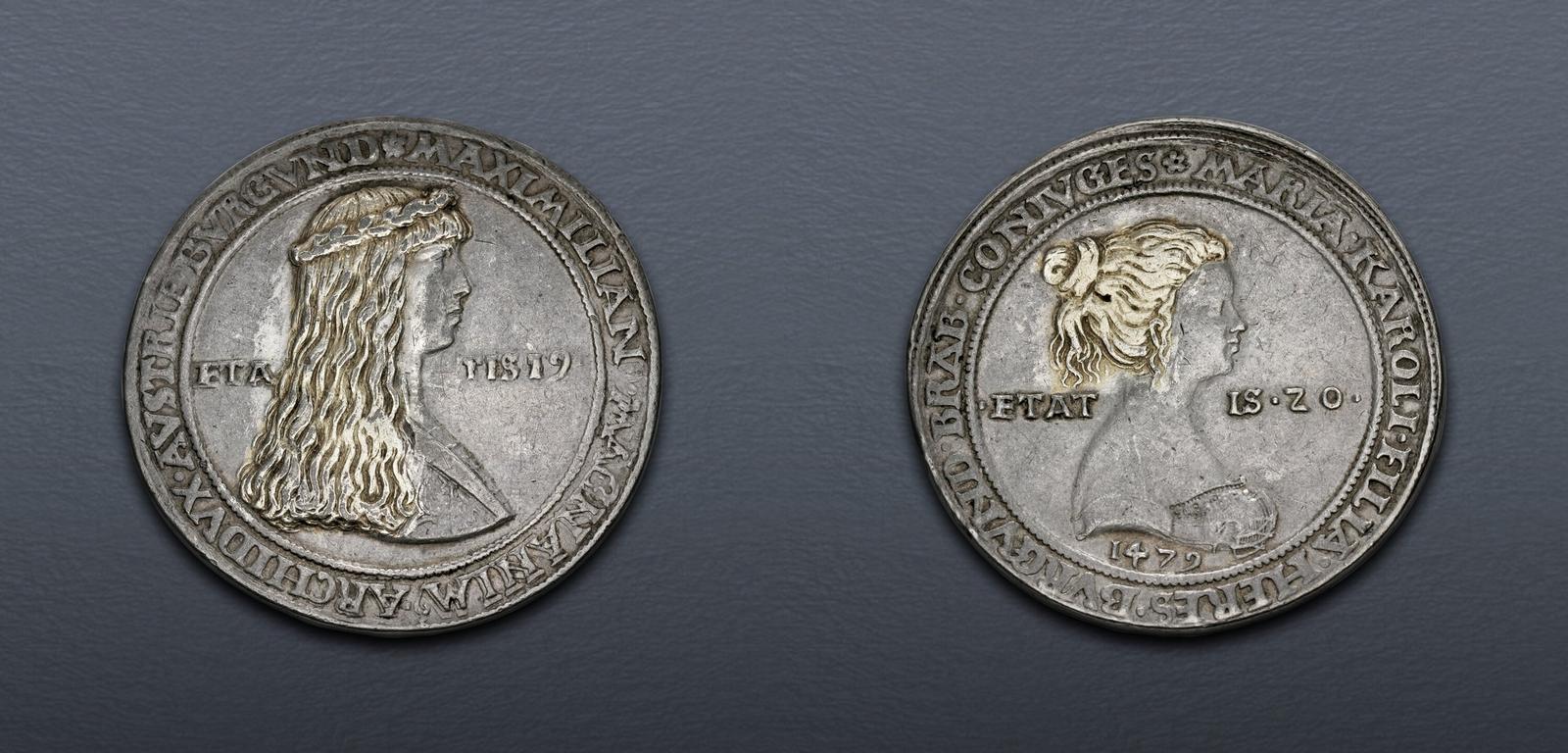
[Image: Gilding is used to accent the hair on this large silver issue dated 1479 issued to celebrate the marriage of the Duke and Duchess of Burgundy that sold for a bid of $9,500 at Classical Numismatic Group’s Triton XXVII auction in January 2024. Courtesy Classical Numismatic Group.]
The U.S. Mint had its first significant bimetallic coin with the 2000 Library of Congress Commemorative $10 coin featuring a gold outer ring and a platinum center that marked the 200th anniversary of the Library of Congress. Twenty years later saw the U.S. Mint release its first colorized coins as part of the Basketball Hall of Fame Commemorative Coin Program. A limited number of silver proof and clad uncirculated coins were colorized on the reverse: the silver dollar had a colored net, rim, and channels on the basketball and the clad half dollar colorized the entire basketball, net and rim. The U.S. Mint used a third-party to colorize the Basketball commemorative coins using an automated process.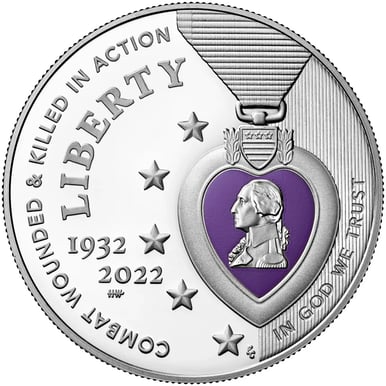 The U.S. Mint cited the Royal Canadian Mint’s popular colorized 25-cent circulating quarter dollar in 2004, explaining, “Coins are colorized by methods such as applying a ‘sticker’ to the surface, adding ink or paint through a computerized ‘printing’ process, or enameling by filling recessed areas with paint.” The overall result is supposed to add dimension and enhance the curvature of the coin, while the bright orange of the basketball on the half dollar and the shared red rim and white netting of the net seen on both the half dollar and dollar match the hues associated with the sport.
[Image: The U.S. Mint further used purple coloration on 25,000 of the Proof 2022-W National Purple Heart Hall of Honor commemorative silver dollars. Courtesy U.S. Mint.]
Dennis, in your time on the Citizens Coinage Advisory Committee, did you ever discuss colorized coins?
Dennis: I remember when David J. Ryder came back to the Mint in the spring of 2018, to serve his second run as the bureau’s director. (His first tenure was in 1992–1993.) This was halfway through my first term on the CCAC. For the previous seven years, after the retirement of Director Edmund Moy, the Mint had been overseen by acting directors and chief executives. Nobody held the Senate-confirmed position of director, until Ryder returned. There was a sense in the air that having an official director—someone formally recommended by the president, and confirmed by the Senate—would bring extra energy to the Mint. Innovation would have some muscle behind it. “There’s only so much an acting director, or a principal deputy director, can do,” as one longtime numismatist told me.
Director Ryder was quick to establish himself as a force for creative change. In his first meeting with the CCAC, he told us his willingness to explore new avenues, to innovate, and look at new products and potential markets. I remember he gave an example of having a coin design showing fireworks, and colorizing it to make the surfaces pop like a real Fourth of July explosion. This was unheard of, for a U.S. Mint director to talk of such things!
The idea of colorizing U.S. coins—of seriously exploring it as a real possibility—was a big change in the creative direction of the Mint. Officials were understandably cautious. They know how strongly opinionated (and conservative) the hobby community can be, and they wanted to carefully monitor and address the public’s perceptions and expectations. The risk, if the colorizing weren’t done right, would be collectors raising an outcry against “cheap gimmicks” or accusing the Mint of making gaudy commercialized novelties.
The first time colorizing the 2020 Basketball Hall of Fame coins was publicly addressed in a CCAC meeting was on July 17, 2019. (Discussions had gone on behind the scenes for some months.)
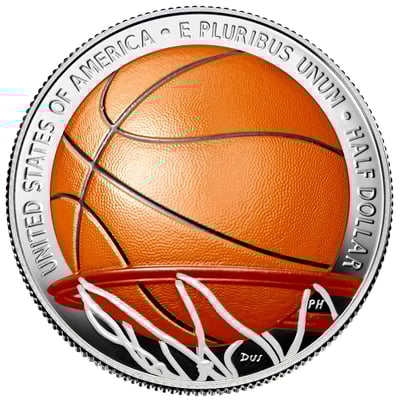
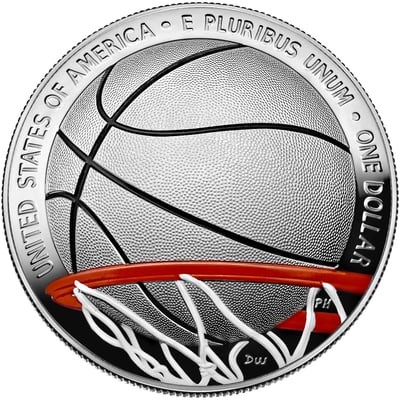
[Image: The Basketball Hall of Fame Colorized 2020 silver dollar features a white net, dark orange rim, and black channels on the basketball while the clad colorized half dollar features an orange basketball with black channels, white net, and dark orange rim. Courtesy U.S. Mint.]
April Stafford, chief of the Office of Design Management, used careful, calm language when she addressed the idea in our July 2019 public meeting. “I’d be remiss if I didn’t share that the United States Mint is considering the use of colorization on this commemorative coin program. I stress the word considering because, of course, if it were done, it would be the first time. So the application of it, the execution of it, really would depend on the decision for a final ‘go’ or ‘no go.’ And the designs would be a large part in driving that.”
She stressed that the Mint wouldn’t jump in and start colorizing everything, willy-nilly. “It would be a subset of each of the offerings for the silver and clad.” She emphasized the “intense research-and-development effort that the Mint would have to engage in, to ensure that the quality of the coins would absolutely be of the highest, highest regard.”
I think the Mint successfully threaded the needle. It managed to move forward into the world of colorized coins—without alienating its customers, and while creating attractive and technologically innovative new products.
Be on the lookout for another installment of Collecting Friends next month or subscribe here and never miss a post! In the meantime, explore beautiful coins from the ANA's Edward C. Rochette Money Museum Virtual Exhibits.
About the Collecting Friends Blog
Hello! And welcome to the ANA’s blog series, “Collecting Friends.”
We decided to approach this much like a conversation between friends. One of us starts with a topic, then the other responds. Simple as that. Along those lines, we’ll keep the tone conversational as much as possible.
We both write about coins professionally, and will keep our relative style guides in our writing. For Dennis, former Publisher at Whitman Publishing, that means capitalizing “Proof” and italicizing Red Book and never saying anything bad about Ken Bressett, who’s awesome anyway.
For Steve, who’s written with Coin World for 15 years, it means Winged Liberty Head dime instead of “Mercury” dime, and similar nuances and oddities. And, it means writing A Guide Book of United States Coins (better known as the “Red Book”).
Both of us started collecting when we were little, introduced to coins by a chance encounter with an old coin that sparked our curiosity. One of Steve’s interests is coin valuation, and he gravitates towards the intersection of art and coins. Dennis enjoys medals and world coins, and studying modern U.S. coins in the context of older series, what came before.
We met in 2012 at the American Numismatic Association World’s Fair of Money in Philadelphia at an event hosted by the Austrian Mint where there was both a Ben Franklin and a Betsy Ross impersonator. We’ve become great friends in the past decade. We even were appointed together to sit on the Citizens Coinage Advisory Committee starting in 2016, but Steve resigned soon after he was appointed to accept a full-time job at the Treasury Department while Dennis was re-appointed in 2020.
We taught a course together on numismatic publishing and writing a few years ago at the Summer Seminar, and while life has gotten in the way of us teaching another class, we jumped at our friend Caleb’s suggestion that we write a column. We hope you enjoy it!
.png?width=300&height=300&name=steve%20roach%20circle%20frame%20(2).png)
.png?width=300&height=300&name=dennis%20tucker%20circle%20frame%20(2).png)
About the American Numismatic Association
The American Numismatic Association is a nonprofit organization dedicated to educating and encouraging people to study and collect coins and related items. The Association serves collectors, the general public, and academic communities with an interest in numismatics.
The ANA helps all people discover and explore the world of money through its vast array of educational programs including its museum, library, publications, conventions and numismatic seminars.