Grading Innovations
Dennis: Dave Bowers and I used to talk quite a bit about coin grading. He felt that the Sheldon system—which turned 75 in 2023, if you can believe it!—is too complicated and cumbersome, especially for newcomers. And yet it’s the system adopted (and adapted) by the American Numismatic Association and used by most coin dealers and collectors.
Dave points out that many collectibles hobbies have grading standards that don’t try so hard to be scientific. Some of his favorite examples involve his interests outside of numismatics; for example, postcards, rare books, and Currier & Ives prints. Book collectors can buy and sell using basic verbal descriptions of a volume’s condition: “new,” “lightly used,” “reading copy,” and the like. Easy to explain, easy to understand.
He would then compare this to the byzantine alphanumeric Sheldon scale—or, rather, what Dr. William Sheldon’s 1948 scale has morphed into over the decades. Adjectives range from “Poor” to “Mint State” (or “Uncirculated”), combined with numbers ranging from 1 to 70, with Mint State going from 60 to 70, and with pluses added by the third-party grading firms to indicate strong die characteristics or special eye appeal. It’s too complex, Dave has often told me, and he invokes Henry David Thoreau: “Simplify, simplify, simplify.”
Some oddities he’s often pointed out:
► A coin professionally graded MS-63 might be more visually appealing than a coin of the same type, date, and mintmark graded MS-65.
► One coin graded MS-65 might have a stronger strike and fuller details than another of the same type/date/mintmark, also graded MS-65.
► Auction and retail prices for the same coin in the same grade can vary dramatically.
► A particular coin, submitted three times for grading, might come back with two or three different grades.
► Objectively differentiating between MS-68 and MS-69 is tilting at windmills.
Dave’s advice is to learn to grade for yourself, use your own best judgement, and look at as many coins as possible, in person, to see differences in grades.
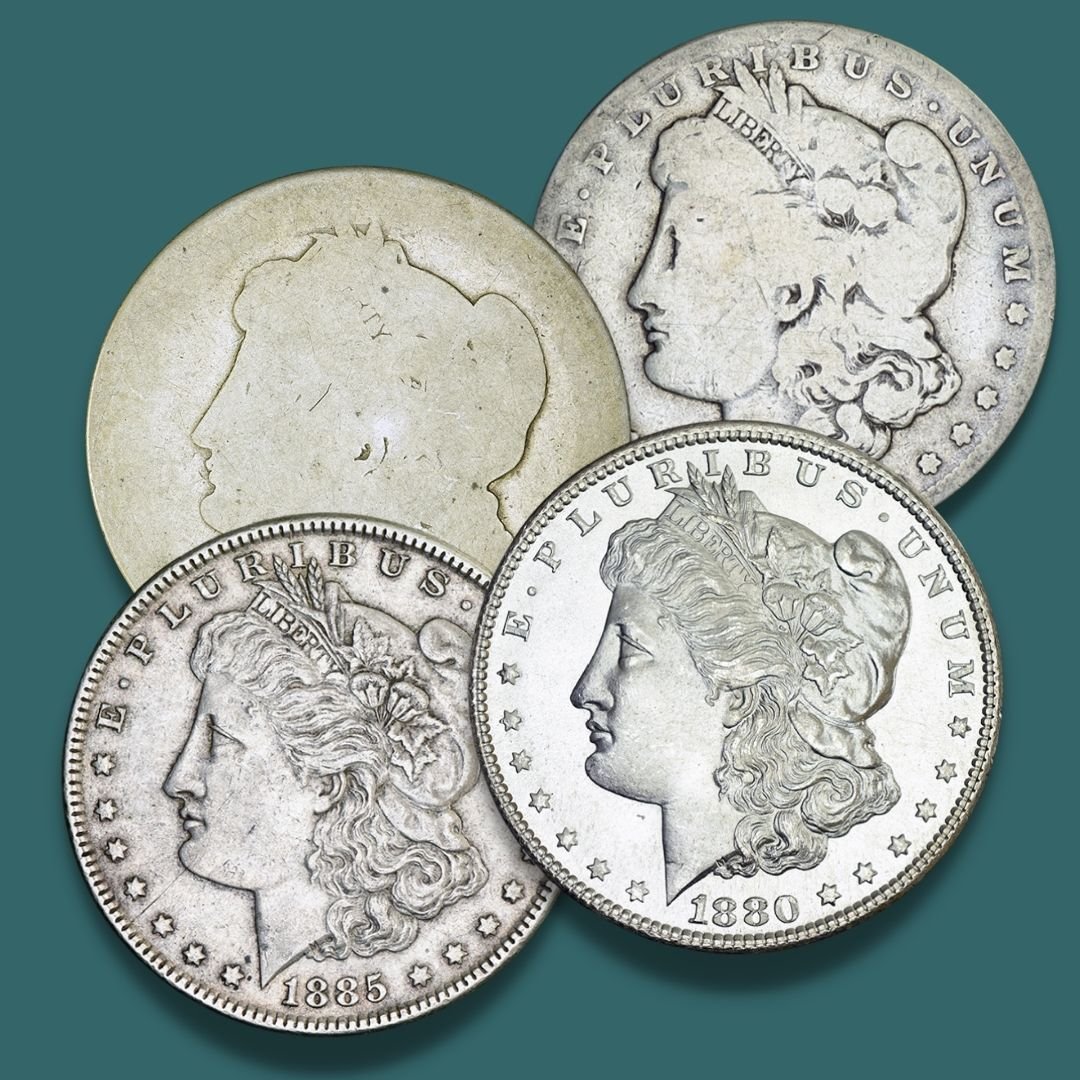
[Image:Varying grades of Morgan Dollars.]
A few years ago, NGC introduced a new 1-through-10 condition scale, called NGCX, that aims to simplify coin grading and make it more like the systems used for comic books and sports cards. A few years before that, professional numismatist Ron Guth (former president of PCGS) developed the Guth 100 Point Coin Grading Scale™. This keeps the circulated grades up to AU-58 (or theoretically -59) and adds 20 more to Mint State and Proof, for a total of 100 possible grades.
Well-known numismatists and big grading firms are pushing for change. Still, Dr. Sheldon appears to be clinging to power from beyond the grave. Is his system the best there is?
Steve, what are your thoughts on modern coin grading?
Steve: I’ve been curious to see if NGCX would grow the hobby and make coins more accessible to non-collectors since the program was launched in January 2023 with NGCX coins made available through select qualifying retailers. The 10-point system seems well-suited to modern coins: 10 is perfection, and anything less is a deviation from that.
NGC relates its new NGCX grading scale to the 1 to 70 Sheldon scale, including this Q&A which asks: I thought coins were graded on a 70-point scale. How does the 10-point scale compare to the 70-point scale? NGC answered: “There is no difference in quality between a grade on the NGCX 10-point grading scale and a grade on the 70-point scale. On the NGCX scale, 10 is the supreme grade, equivalent to a 70 on the traditional scale. The subsequent grades cascade from 10, a criterion understood by all.”
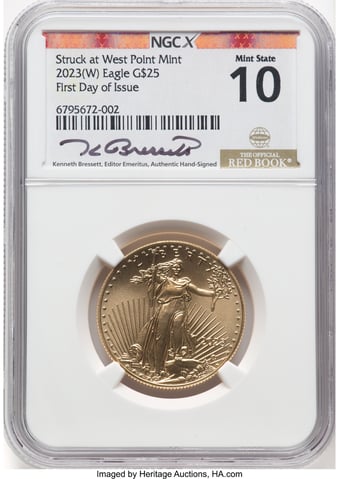
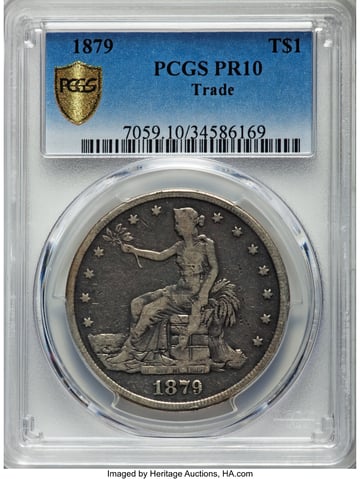
[Image 1: The NGCX scale is 10 points, with nearly all modern issues grading 9.9 or 10. Image 2: A Proof 10 coin on the NGCX grading scale is essentially perfect, while one graded Proof 10 – like this 1879 Trade dollar which was a Proof only issue, even though no Proof characteristics remain – has extensive wear. It sold for $810 at a 2018 Heritage auction.
Courtesy Heritage Auctions.]
So, a coin graded Proof 70 by NGC’s traditional use of the Sheldon scale would be graded Proof 10 under the new NGCX system. This surely would be confusing for those who collect coins like Proof only issues like 1879 to 1885 Trade dollars, where some of these were later worn down as pocket pieces or accidentally entered circulation. Under PCGS and NGC’s standards, a coin like an 1879 Trade dollar graded Proof 10 would have 50 points of wear, with the Proof prefix recognizing that the coin was initially struck as a Proof, even though no more visual signifiers of Proof – like reflective, mirrored fields – remain. A Proof 10 under the NGCX scale would indicate that the coin is essentially perfect while a Proof 10 under the Sheldon scale indicates a coin is a nice Very Good. Wacky stuff, but thankfully, the people buying a modern Proof or Uncirculated American Eagle gold or silver bullion coin graded NGCX 10 will likely not be the same collector buying a circulated Proof Trade dollar!
Be on the lookout for another installment of Collecting Friends next month or subscribe here and never miss a post! In the meantime, explore beautiful coins from the ANA's Edward C. Rochette Money Museum Virtual Exhibits.
About the Collecting Friends Blog
Hello! And welcome to the ANA’s blog series, “Collecting Friends.”
We decided to approach this much like a conversation between friends. One of us starts with a topic, then the other responds. Simple as that. Along those lines, we’ll keep the tone conversational as much as possible.
We both write about coins professionally, and will keep our relative style guides in our writing. For Dennis, former Publisher at Whitman Publishing, that means capitalizing “Proof” and italicizing Red Book and never saying anything bad about Ken Bressett, who’s awesome anyway.
For Steve, who’s written with Coin World for 15 years, it means Winged Liberty Head dime instead of “Mercury” dime, and similar nuances and oddities. And, it means writing A Guide Book of United States Coins (better known as the “Red Book”).
Both of us started collecting when we were little, introduced to coins by a chance encounter with an old coin that sparked our curiosity. One of Steve’s interests is coin valuation, and he gravitates towards the intersection of art and coins. Dennis enjoys medals and world coins, and studying modern U.S. coins in the context of older series, what came before.
We met in 2012 at the American Numismatic Association World’s Fair of Money in Philadelphia at an event hosted by the Austrian Mint where there was both a Ben Franklin and a Betsy Ross impersonator. We’ve become great friends in the past decade. We even were appointed together to sit on the Citizens Coinage Advisory Committee starting in 2016, but Steve resigned soon after he was appointed to accept a full-time job at the Treasury Department while Dennis was re-appointed in 2020.
We taught a course together on numismatic publishing and writing a few years ago at the Summer Seminar, and while life has gotten in the way of us teaching another class, we jumped at our friend Caleb’s suggestion that we write a column. We hope you enjoy it!
.png?width=300&height=300&name=steve%20roach%20circle%20frame%20(2).png)
.png?width=300&height=300&name=dennis%20tucker%20circle%20frame%20(2).png)
About the American Numismatic Association
The American Numismatic Association is a nonprofit organization dedicated to educating and encouraging people to study and collect coins and related items. The Association serves collectors, the general public, and academic communities with an interest in numismatics.
The ANA helps all people discover and explore the world of money through its vast array of educational programs including its museum, library, publications, conventions and numismatic seminars.