

Red Coins
Steve: A column or so ago, we discussed colorized coins and the distinction between coins that have color added to them as part of the minting process and those that acquire color naturally over time. U.S. copper coins are typically identified as having three colors: Red, Red and Brown, and Brown.
I keep a clippings folder with ideas of things to write about (as one does) and an article from a Sotheby’s magazine from around a decade ago discussed the power of red. Wine specialist Serena Sutcliffe discussed how red wines are desirable over other varieties because they have gravitas. “There’s something about the color, it’s emphatic with connotations in western culture of religion and communion, and in Asian cultures with health, wealth, happiness and luck,” she said, while distinguishing between the different reds of a Burgundy or a Bordeaux.
She explained the slow change of wine over time – just like a copper coin changes as it reacts with its environment. More vivid when new, though “as the years go by you see the tone getting less purple and more crimson, and eventually, with very old wine, turning a brownish red.”
Copper coin enthusiasts have their own definitions of what constitutes Red versus Red and Brown, with PCGS identifying Red as a coin graded Mint State or Proof 60 or better and retaining 95 percent or more of its original mint red color. NGC explains that Brown designates a copper coin that has mostly brown patina, with five percent or less of its original mint red luster remaining. Older red coins are susceptible to mellowing over time, and in price guides and in the marketplace, coins with Red designations sell for more than coins with Red and Brown or Brown designations.
Within art valuation, red is a desirable color in a work and a few red brushstrokes to articulate a figure or a structure can save a landscape from being dull. It’s a general idea that all things equal, red paintings sell better: the only painting that Vincent Van Gogh sold in his lifetime was The Red Vineyard which is in the Pushkin Museum in Moscow.
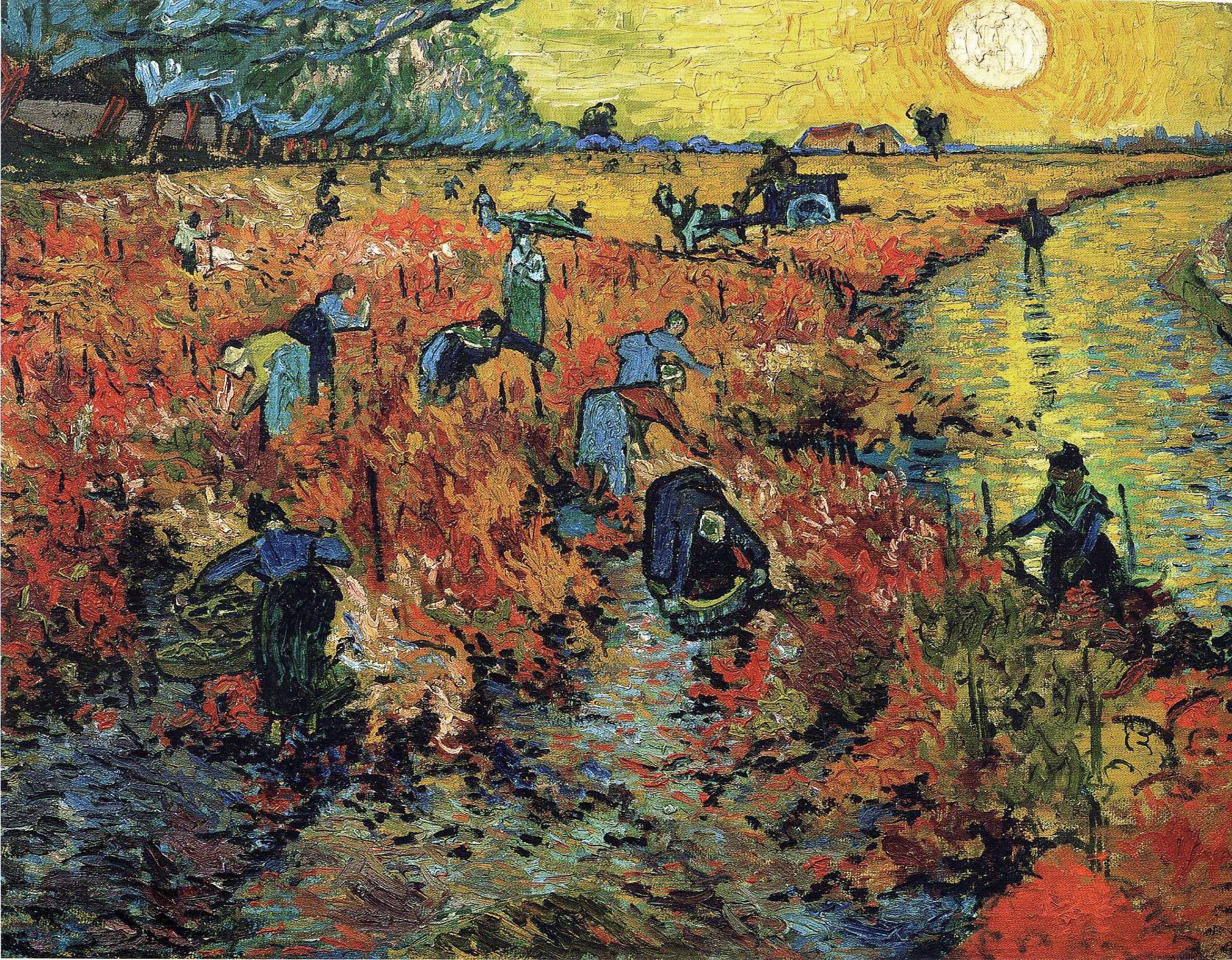
[A red vineyard, completely red like red wine,” Vincent van Gogh wrote to his brother Theo. Painted from memory in late 1888, The Red Vineyard illustrates the sheer visual power and market allure of the color red, a trait shared by highly prized, original-luster copper coinage.]
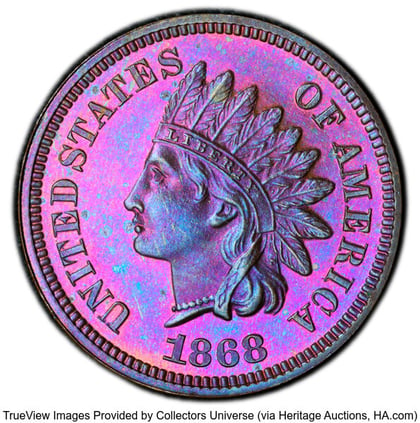
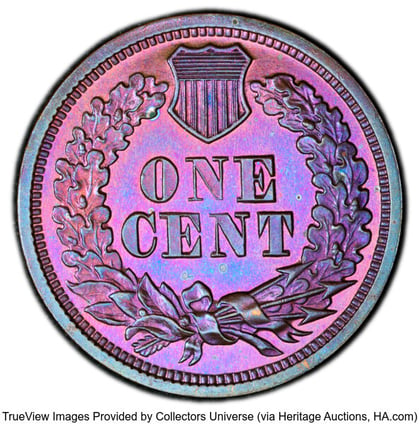
[PCGS designated this 1868 Indian Head cent Proof 66 Brown, though its mirrored surfaces reflect vibrant magenta and blue hues, in defiance of the brown color designation. Images courtesy of Heritage Auctions.]
Dennis, do you prefer your copper coins with full original red color, or do you prefer a bit more mellowing?
Dennis: Steve, your writing makes me want to order a steak and a glass of good red wine. I can close my eyes and smell it and taste it! But I have to confess, when it comes to coins, my answer to this question is sadly fear-based. I’m kinda scared of the color red.
I love the look of an old copper coin or medal that’s kept its beautiful red color over time. But deep in the back of my mind, an anxious voice whispers, “It won’t last forever.”
For a copper coin to maintain its red luster, there has to be an almost magical confluence of proper environment, deliberate preservation or conservation, and conscious care when handling. Anything can go wrong! An accidental fingerprint will bloom over time into a glaring latticework on that pristine surface. A microscopic fleck of moisture can expand into a dark pimple. Resting on the wrong surface can bring on a rainbow of colorization—maybe attractive, maybe not. And as the red luster disappears, depending on how it looks, the coin’s value can go down.
(That entire last paragraph is the anxious voice whispering.)
I do love full original red color on copper. And Dave Bowers and Rick Snow and other specialists extol the wonders of red copper (especially old Proofs) gently toned with age to eye-pleasing magentas, purples, and blues. I like all of that. But for the sake of my irrational anxiety, give me a nice, molecularly stable, rich chocolate-brown!
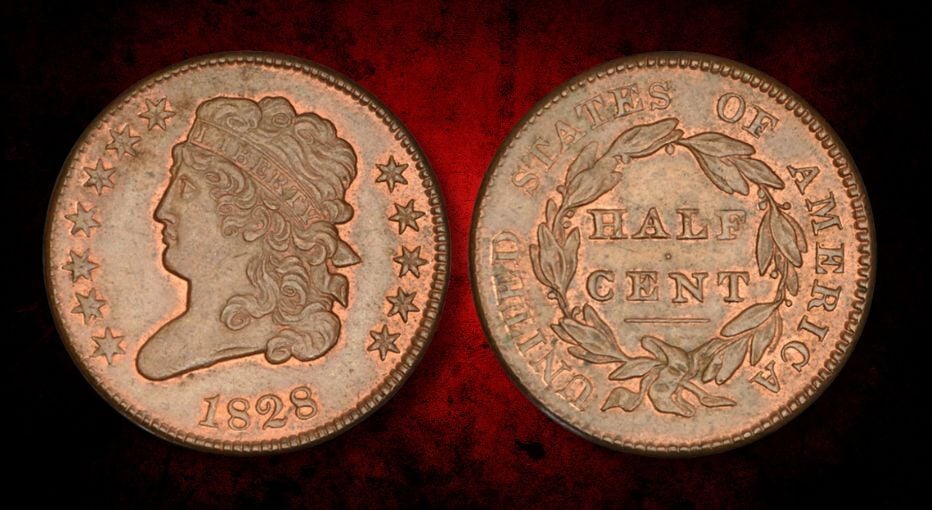
[Caught mid-transition: This 1828 Classic Head Half Cent beautifully illustrates what happens when a copper coin "mellows" over time. While chocolate-brown patina has claimed the high, exposed details of Liberty's portrait, bright original mint red luster remains perfectly preserved within the protective recesses.]
Be on the lookout for another installment of Collecting Friends next month or subscribe here and never miss a post! In the meantime, explore beautiful coins from the ANA's Edward C. Rochette Money Museum Virtual Exhibits.
About the Collecting Friends Blog
Hello! And welcome to the ANA’s blog series, “Collecting Friends.”
We decided to approach this much like a conversation between friends. One of us starts with a topic, then the other responds. Simple as that. Along those lines, we’ll keep the tone conversational as much as possible.
We both write about coins professionally, and will keep our relative style guides in our writing. For Dennis, former Publisher at Whitman Publishing, that means capitalizing “Proof” and italicizing Red Book and never saying anything bad about Ken Bressett, who’s awesome anyway.
For Steve, who’s written with Coin World for 15 years, it means Winged Liberty Head dime instead of “Mercury” dime, and similar nuances and oddities. And, it means writing A Guide Book of United States Coins (better known as the “Red Book”).
Both of us started collecting when we were little, introduced to coins by a chance encounter with an old coin that sparked our curiosity. One of Steve’s interests is coin valuation, and he gravitates towards the intersection of art and coins. Dennis enjoys medals and world coins, and studying modern U.S. coins in the context of older series, what came before.
We met in 2012 at the American Numismatic Association World’s Fair of Money in Philadelphia at an event hosted by the Austrian Mint where there was both a Ben Franklin and a Betsy Ross impersonator. We’ve become great friends in the past decade. We even were appointed together to sit on the Citizens Coinage Advisory Committee starting in 2016, but Steve resigned soon after he was appointed to accept a full-time job at the Treasury Department while Dennis was re-appointed in 2020.
We taught a course together on numismatic publishing and writing a few years ago at the Summer Seminar, and while life has gotten in the way of us teaching another class, we jumped at our friend Caleb’s suggestion that we write a column. We hope you enjoy it!
.png?width=300&height=300&name=steve%20roach%20circle%20frame%20(2).png)
.png?width=300&height=300&name=dennis%20tucker%20circle%20frame%20(2).png)
About the American Numismatic Association
The American Numismatic Association is a nonprofit organization dedicated to educating and encouraging people to study and collect coins and related items. The Association serves collectors, the general public, and academic communities with an interest in numismatics.
The ANA helps all people discover and explore the world of money through its vast array of educational programs including its museum, library, publications, conventions and numismatic seminars.