This Deceptive Clickbait Headline Is Worth Millions!
Dennis: Counterfeit coins have been a pox on the hobby for generations. Our grandparents had to look out for fake colonial coppers, fake key dates (like the 1909-S V.D.B. Lincoln cent and the 1916-D Mercury dime), and fake gold coins of every denomination and type.
Over the past 25 years or so, counterfeiters, mostly in China, have grown more and more sophisticated in their devilish craft. Now they can fabricate very deceptive fake coins in large quantities—even complex pieces like American Silver Eagles in deep-mirror Proof format. Not stopping at the coins themselves, they create counterfeit plastic slabs that look like the ones made by professional third-party grading/authenticating firms.
Today we have yet another swarm of deception to torment us like mosquitoes at a picnic. Thankfully (if that’s the right word?) these aren’t physical counterfeits, but virtual ones. And it’s not fake coins, but rather fake information, in the form of clickbait headlines.
“This Wheat cent is worth $100 million!” “Don’t spend this Bicentennial quarter!” “This $250,000 coin can be found in circulation!”
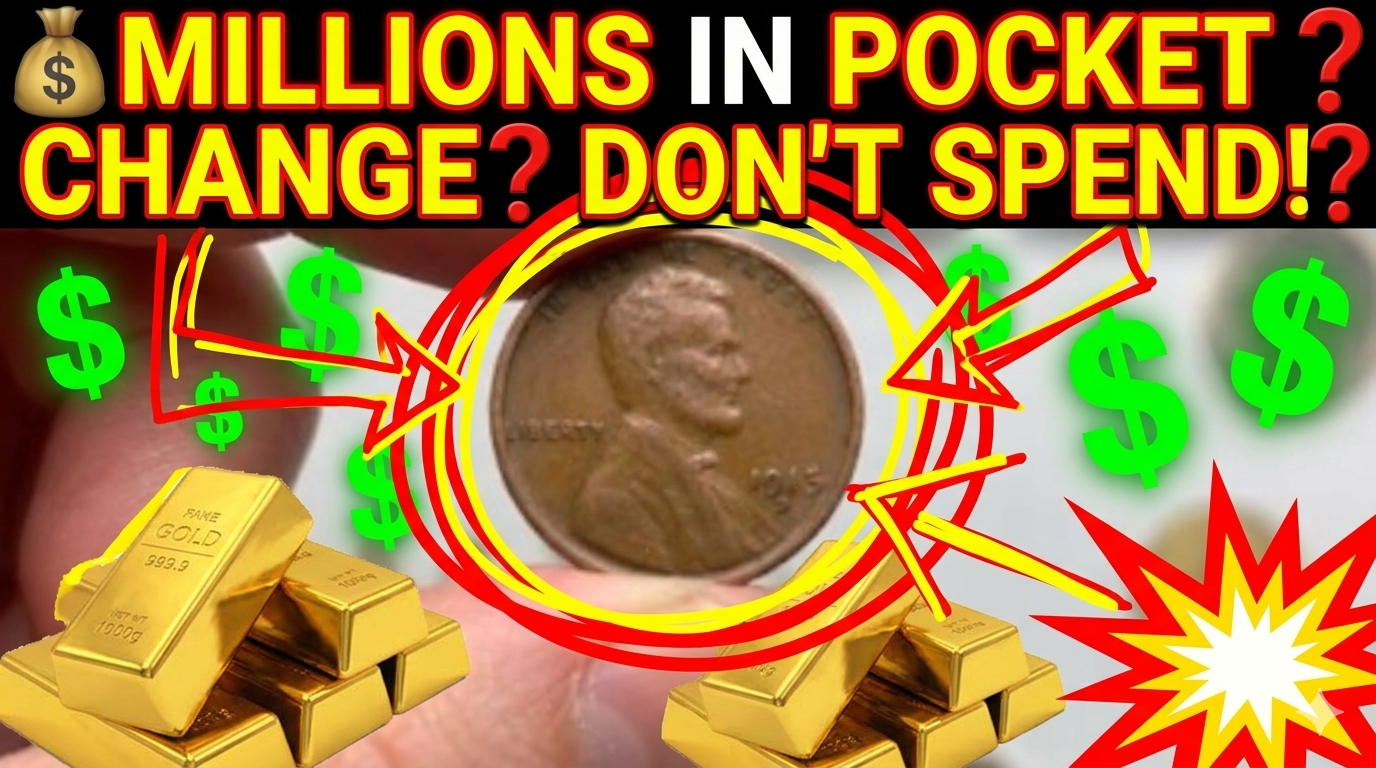
[Image: Anatomy of a coin clickbait thumbnail. Note the use of blurry, nondescript images, exaggerated claims of wealth, and aggressive red arrows designed to manipulate search algorithms and trick viewers into clicking. Often created by AI.]
These ads—sometimes brightly colored, sometimes plain, but always promising outrageous riches—are like catnip, and the unsuspecting non-collector public are the innocent kittens. Who wouldn’t be tempted by a headline promising a windfall from coins you can find in your pocket change?
But heed the warning of Michael Nottelmann, U.S. numismatist at Harlan J. Berk in Chicago. In a recent Newman Numismatic Portal Symposium talk, he said, “Clickbaiters are just interested in clicks for their video.” That’s how they monetize their efforts—not by providing real value. Click the link, and you get a junk video.
What you won’t get is education. “An educator will take their time, and make sure the message is being communicated clearly,” Mike says. “An educator will show you in detail what they’re talking about, and answer questions.”
Clickbait headlines don’t lead you down that path.
The clickbait videos, Mike Nottelmann points out, are vague and unclear. They don’t give detailed answers, or tell you where you can find more information. There are plenty of content creators who actually do make detailed educational videos about coins. Mike gives examples of good numismatic sites. You can watch his talk online at bit.ly/nnpvideo.
He recommends rewarding the good guys with your attention and “paying” them with the currency of the online world: “Like, share, and subscribe.” “This is what you do for people who have good content,” he says. “Put a comment in it, give it a like, or subscribe. All of these things feed the algorithm that will push the good stuff into other people’s feeds.”
If you see something that looks like clickbait, even if it looks “fun” and you think you’ll get a laugh watching it, don’t click. That boosts the algorithms for the clickbaiters, and makes their garbage harder to combat.
Michael Bugeja is another numismatist who’s been educating non-collectors about deceptive headlines and warning the hobby community about clickbait. It’s like sweeping sand off the beach. Michael’s frustration is palpable, but he keeps at it. He fights the good fight at proxiblog.org.
Steve, have you had any run-ins with these clickbait headlines and junk videos?
Steve: Yes! As an appraiser, I occasionally get inquiries about a few specific issues that are nearly always worth little more than face value, like 1965 and 1776-1976 dual-dated Washington quarter dollars. A persistent question comes for a less familiar issue: the 1971 two pence which says NEW PENCE from Great Britain. The low-denomination type was introduced as the nation went to decimalization in 1971. 1982 saw the Royal Mint change the reverse wording from NEW PENCE to TWO PENCE and there were some 1983 2p coins with NEW PENCE on the reverse that were sold as part of sets. The chances of finding one of the rare 1983 “New Pence 2p” coins in circulation remains essentially impossible since all of the 1983 “New Pence” coins that have been discovered since then were found in the Martini and Heinz-branded mint sets of that year.
The Royal Mint struck 1,454,856,250 1971-dated 2p coins, and they are all excruciatingly common. Rumors that any 2p with the NEW PENCE is rare remain so persistent that the Royal Mint addresses it on its website, writing: “Since there are relatively few coins with the date 1983 and the inscription 'NEW PENCE' in circulation, they may well have a value higher than face value to a collector. The Royal Mint is, however, unable to comment on the value of any individual coin and we would recommend that you should consult a coin dealer,” providing a link to the British Numismatic Trade Association. A look at current online offerings shows that around 450 of the 1983 Two Pence “New Pence” issues are thought to exist and examples sell for well-over $1,000 today.
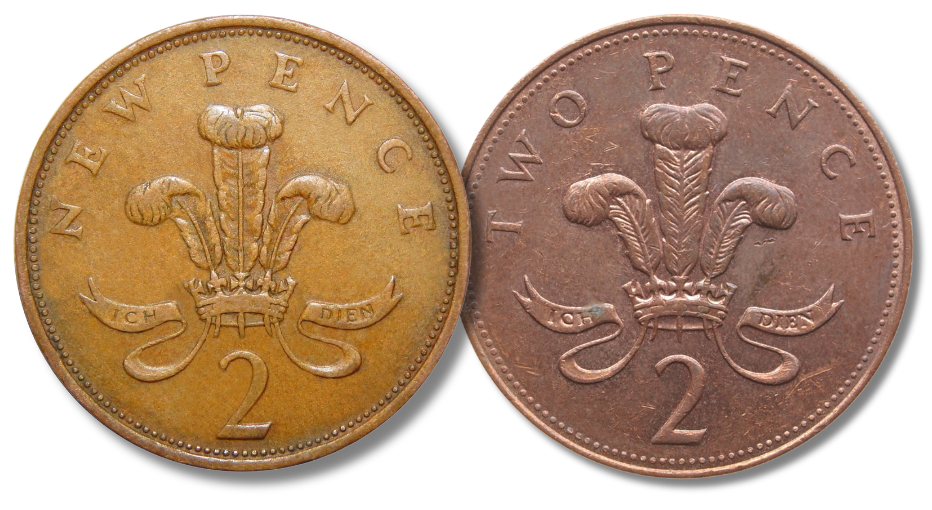
[The common "New Pence" reverse (left) was officially replaced by "Two Pence" (right) in 1982. Clickbait campaigns often exploit this visual shift, tricking non-collectors into believing common 1970s coins are the ultra-rare 1983 error.]
Be on the lookout for another installment of Collecting Friends next month or subscribe here and never miss a post! In the meantime, explore beautiful coins from the ANA's Edward C. Rochette Money Museum Virtual Exhibits.
About the Collecting Friends Blog
Hello! And welcome to the ANA’s blog series, “Collecting Friends.”
We decided to approach this much like a conversation between friends. One of us starts with a topic, then the other responds. Simple as that. Along those lines, we’ll keep the tone conversational as much as possible.
We both write about coins professionally, and will keep our relative style guides in our writing. For Dennis, former Publisher at Whitman Publishing, that means capitalizing “Proof” and italicizing Red Book and never saying anything bad about Ken Bressett, who’s awesome anyway.
For Steve, who’s written with Coin World for 15 years, it means Winged Liberty Head dime instead of “Mercury” dime, and similar nuances and oddities. And, it means writing A Guide Book of United States Coins (better known as the “Red Book”).
Both of us started collecting when we were little, introduced to coins by a chance encounter with an old coin that sparked our curiosity. One of Steve’s interests is coin valuation, and he gravitates towards the intersection of art and coins. Dennis enjoys medals and world coins, and studying modern U.S. coins in the context of older series, what came before.
We met in 2012 at the American Numismatic Association World’s Fair of Money in Philadelphia at an event hosted by the Austrian Mint where there was both a Ben Franklin and a Betsy Ross impersonator. We’ve become great friends in the past decade. We even were appointed together to sit on the Citizens Coinage Advisory Committee starting in 2016, but Steve resigned soon after he was appointed to accept a full-time job at the Treasury Department while Dennis was re-appointed in 2020.
We taught a course together on numismatic publishing and writing a few years ago at the Summer Seminar, and while life has gotten in the way of us teaching another class, we jumped at our friend Caleb’s suggestion that we write a column. We hope you enjoy it!
.png?width=300&height=300&name=steve%20roach%20circle%20frame%20(2).png)
.png?width=300&height=300&name=dennis%20tucker%20circle%20frame%20(2).png)
About the American Numismatic Association
The American Numismatic Association is a nonprofit organization dedicated to educating and encouraging people to study and collect coins and related items. The Association serves collectors, the general public, and academic communities with an interest in numismatics.
The ANA helps all people discover and explore the world of money through its vast array of educational programs including its museum, library, publications, conventions and numismatic seminars.